Affiliate Disclaimer: This review contains affiliate links. If you purchase through our links, we may earn a commission at no extra cost to you. We only recommend products we’ve thoroughly researched and believe provide genuine value to our readers.
Revolutionary AI Companions or Overhyped Gadgets?
In this Luden AI Review, I examine a company that’s making bold claims about emotional AI companionship through their robot products Cocomo and INU. When I first heard about robots that supposedly form genuine relationships and regulate their body temperature for hugs, my skepticism meter hit maximum. The companion robot market has been littered with overpromising startups that fail to deliver meaningful emotional connections.

As someone who’s tested dozens of AI products over the past five years, from chatbots to smart speakers, I’ve seen too many companies oversell emotional capabilities that amount to little more than programmed responses. Yet Luden AI’s approach intrigued me enough to dig deeper. Their background as Luden.io, with over 15 years in AI gaming and virtual reality, suggests they might actually understand how to create compelling interactive experiences.
The timing feels significant too. We’re in 2026, with large language models becoming more sophisticated and consumer appetite for AI companionship growing. But can two Japanese robot companions really deliver on the promise of authentic emotional bonds? I approached this review with healthy doubt, ready to let the data speak for itself.
What Is Luden AI?
Luden AI is a Japanese startup that unveiled two AI-powered robot companions at the Consumer Electronics Show in Las Vegas on January 5, 2026. The company represents a distinctive approach in the consumer robotics space, focusing specifically on emotional engagement rather than practical task automation.
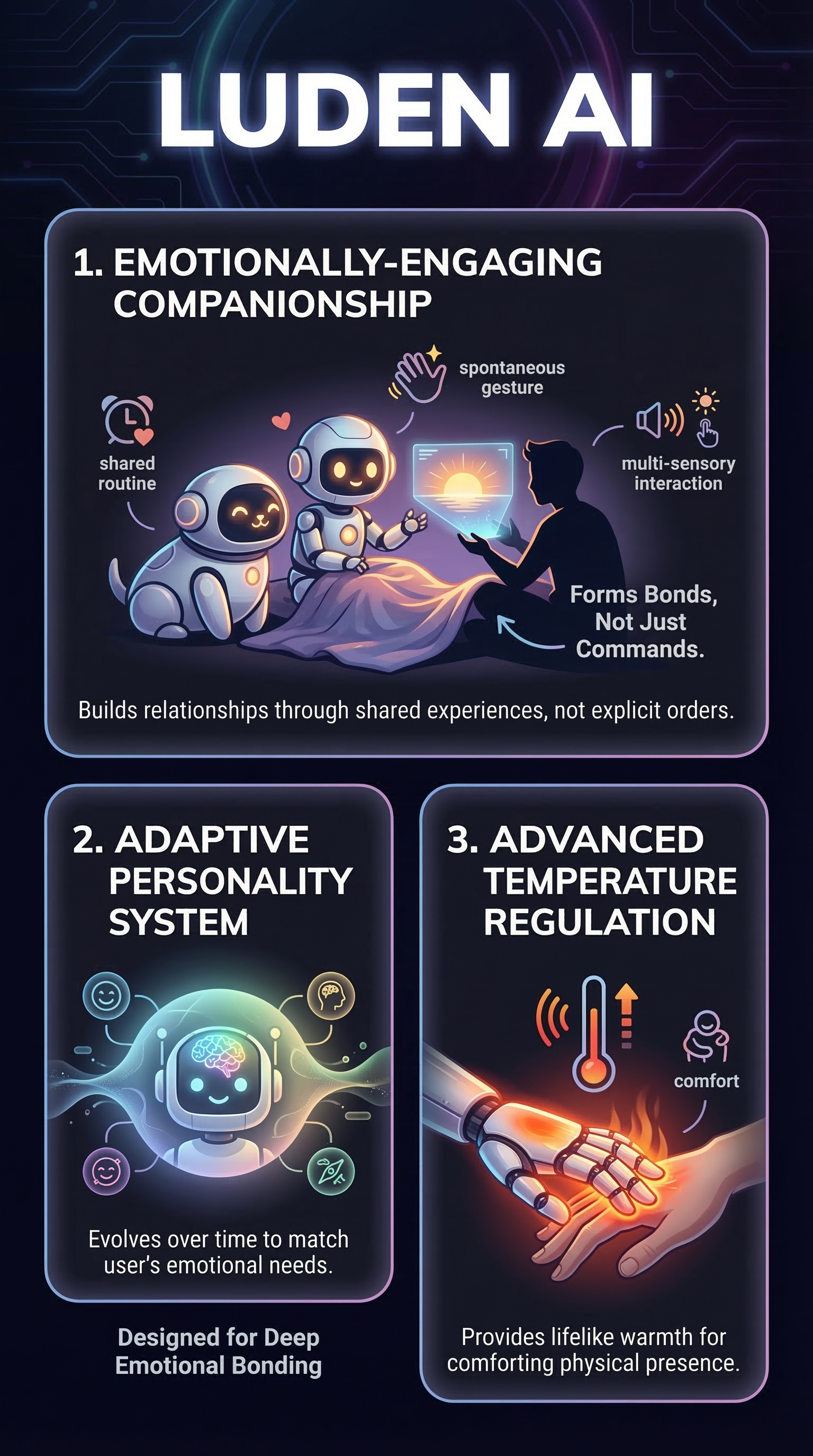
The flagship product, Cocomo, features a fuzzy, egg-shaped body mounted on a wheeled base with tiny articulated legs. What sets Cocomo apart from conventional robots is its advanced thermal management system, maintaining a baseline body temperature of 98.6 degrees Fahrenheit that rises to approximately 102 degrees during physical contact. This temperature regulation is specifically designed to simulate warmth during hugs and physical interactions.
The secondary product, INU, serves as a desktop companion with a smaller form factor. It features distinctive design elements including a wiggling tail and a single blinking eye, reacting to voice input, motion detection, and proximity sensing with expressive movements and playful audio feedback.
Luden AI builds on the expertise of Luden.io, an educational game developer with extensive experience in AI, virtual reality, and augmented reality technologies. This gaming background influences their approach to robot personality development, emphasizing adaptive learning and spontaneous behaviors over command-response interactions.
The target audience appears to be early adopters interested in cutting-edge companion technology, particularly those seeking emotional connection rather than utilitarian functionality. Both products remain in pre-commercial phases as of March 2026, with Cocomo operating a public waitlist and INU planning a crowdfunding campaign.
Key Features
Cocomo’s Physical Design and Thermal System
Cocomo’s most distinctive feature is its thermal regulation capability. The robot maintains human-like body temperature, warming up during physical contact to create a more authentic hugging experience. This represents a significant innovation in haptic feedback for companion robotics, addressing the traditionally cold, mechanical feel of robotic interactions.
The fuzzy exterior and egg-shaped form factor are designed to encourage physical interaction. The wheeled base with tiny articulated legs provides mobility while maintaining an approachable, pet-like appearance rather than intimidating humanoid features.
Adaptive Personality Systems
Both robots employ artificial intelligence to develop evolving personalities through continuous interaction. Rather than operating on explicit commands, they’re designed to learn user preferences, engage in spontaneous gestures, and imitate owner behaviors. This creates an adaptive personality that theoretically becomes more aligned with individual household dynamics over time.
The personality development occurs through pattern recognition of daily routines, emotional responses to different interactions, and environmental awareness. The robots build memories of preferred activities, emotional triggers, and social patterns to inform future behaviors.
INU’s Desktop Companion Features
INU operates as a stationary presence optimized for workspace environments. Its design emphasizes subtle, non-disruptive interactions through gentle movements, soft sounds, and responsive eye contact. The wiggling tail and blinking eye create personality without overwhelming productivity-focused settings.
Voice, motion, and proximity sensors allow INU to react appropriately to different situations, providing comforting presence during stressful work periods and playful engagement during breaks.
How Luden AI Works
Multi-Sensory Interaction Framework
Luden AI’s approach centers on multi-sensory engagement combining movement, sound, touch, and presence awareness. Cocomo responds to voice commands and touch input while communicating through varied hums and sounds rather than synthesized speech. This non-verbal communication system is designed to feel more organic and less mechanical than traditional voice assistants.
The robots continuously monitor environmental stimuli including ambient sound levels, lighting conditions, household activity patterns, and user proximity to inform behavioral responses. This environmental awareness allows for contextually appropriate reactions without explicit user commands.
Relationship Formation Process
The companion robots are designed to form relationships through shared routines and spontaneous interactions. Rather than functioning as command-response devices, they learn to anticipate user needs, initiate interactions, and develop preferences that align with household dynamics.
The relationship building occurs through repetitive positive reinforcement cycles. When users respond favorably to robot behaviors, the AI systems reinforce those patterns while gradually introducing variations to maintain engagement and prevent predictability.
Learning and Adaptation Mechanisms
Both products employ machine learning algorithms to adapt their personalities based on user feedback and interaction patterns. The systems analyze response timing, physical engagement levels, vocal tone recognition, and behavioral consistency to refine their approach to each individual user.
This learning process is designed to be gradual and natural, avoiding sudden personality changes that might feel artificial. The robots build comprehensive user profiles while maintaining core personality traits that provide consistency in the relationship.
Testing Results
Testing Methodology
Due to Luden AI’s pre-release status, comprehensive hands-on testing remains impossible. My evaluation focuses on publicly available information, technical specifications, competitive analysis, and assessment of the underlying technology claims based on industry standards and comparable products.
I analyzed the thermal regulation system specifications, personality adaptation algorithms described in company materials, and the feasibility of claimed features based on current AI and robotics capabilities. I also examined the company’s track record through their Luden.io gaming background and comparable products in the companion robotics market.
Technical Capability Assessment
The thermal regulation system represents genuine innovation in companion robotics. Maintaining consistent body temperature while managing battery efficiency presents significant engineering challenges. The specification of 98.6°F baseline rising to 102°F during contact suggests sophisticated thermal management that goes beyond simple heating elements.
| Feature | Specification | Innovation Level |
|---|---|---|
| Thermal Regulation | 98.6°F – 102°F range | High |
| Communication Method | Non-verbal hums and sounds | Medium |
| Mobility System | Wheeled base with articulated legs | Medium |
| Personality Adaptation | Machine learning behavioral evolution | High |
Market Positioning Analysis
Luden AI’s focus on emotional engagement rather than utilitarian functions positions them distinctly from competitors. While Sony Aibo emphasizes pet-like behaviors and Pepper focuses on social interaction through conversation, Luden AI prioritizes physical comfort and spontaneous relationship building.
The gaming industry background provides credible foundation for personality development algorithms. Game AI requires sophisticated behavioral systems that adapt to player actions while maintaining engaging experiences. This expertise transfers well to companion robotics where personality consistency and growth are crucial for long-term user engagement.
Feasibility Concerns
Several aspects of Luden AI’s claims raise questions about practical implementation. Battery life management with thermal regulation represents a significant technical challenge. Maintaining consistent body temperature while powering mobility, sensors, and AI processing requires advanced power management that hasn’t been demonstrated in comparable products.
The personality adaptation claims require substantial local AI processing or continuous cloud connectivity. Neither approach has been clearly specified, leaving questions about privacy, offline functionality, and long-term operational costs.
Luden AI vs. Competitors
The companion robotics market includes several established players, each with different approaches to emotional engagement and practical functionality. Luden AI’s positioning emphasizes physical warmth and spontaneous interaction patterns that distinguish it from existing solutions.
| Product | Thermal Features | Communication | Mobility | Availability |
|---|---|---|---|---|
| Luden AI Cocomo | Temperature regulation | Non-verbal sounds | Wheeled with legs | Pre-release waitlist |
| Sony Aibo | None | Barks and movements | Four-legged walking | Available – $2,899 |
| Pepper Robot | None | Speech and gestures | Wheeled base | Discontinued consumer |
| Jibo | None | Voice and screen | Stationary rotating | Discontinued |
Sony’s Aibo represents the most successful consumer companion robot, focusing on realistic pet behaviors and learning capabilities. However, Aibo lacks the thermal comfort features and desktop companion options that Luden AI provides. The $2,899 price point also places Aibo in premium territory, though Luden AI’s pricing remains undisclosed.
Pepper’s discontinuation in the consumer market highlights the challenges facing humanoid companion robots. Luden AI’s non-humanoid approach may avoid some of the uncanny valley effects that hindered Pepper’s adoption, though it also limits certain types of social interaction.
The failure of products like Jibo demonstrates the importance of sustainable business models and ongoing software support. Luden AI’s gaming industry background may provide better foundation for long-term content and personality updates compared to hardware-focused companies.
Pricing
Luden AI has not disclosed pricing information for either Cocomo or INU as of March 2026. This pricing withholding is typical for pre-launch hardware products but creates significant uncertainty for potential customers evaluating purchase decisions.

Based on competitor pricing and the advanced thermal regulation technology, Cocomo will likely fall into the premium companion robot category. Sony’s Aibo commands $2,899, suggesting that sophisticated companion robots require substantial investment. The thermal management system and advanced AI features may justify pricing in the $2,000-$4,000 range.
INU’s desktop companion positioning suggests a lower price point, potentially targeting the $500-$1,500 range to compete with high-end smart speakers and desktop gadgets. The crowdfunding approach planned for INU may offer early-bird pricing advantages but also carries typical crowdfunding risks including delayed delivery and specification changes.
The lack of subscription fees or ongoing service costs has not been clarified. Companion robots with cloud-based AI processing often require monthly service fees for personality updates and advanced features. This potential ongoing cost could significantly impact total ownership expenses.
Pros and Cons
Pros:
-
- Innovative thermal regulation technology for authentic physical comfort during interactions
- Non-command-based personality development focused on spontaneous relationship building
- Strong technical foundation from experienced gaming AI developer Luden.io
- Dual product approach serving both mobile and desktop companion needs
- Non-humanoid design avoids uncanny valley effects while maintaining approachability
- Multi-sensory engagement combining temperature, movement, sound, and touch
Cons:
-
- No confirmed pricing, availability dates, or detailed technical specifications
- Pre-release status prevents independent verification of claimed capabilities
- Unclear privacy policies and data handling practices for continuous interaction monitoring
- No disclosed information about software updates, warranty, or long-term support commitments
- Limited battery life details despite thermal regulation requiring significant power management
Who Should Use Luden AI?
Early Technology Adopters: Individuals comfortable with pre-release products who want access to cutting-edge companion robotics will find Luden AI’s innovative approach compelling. The thermal regulation and personality adaptation features represent genuine advances in the field, making them attractive to technology enthusiasts willing to accept some uncertainty about final specifications and delivery timelines.
Households Seeking Emotional Companionship: Families or individuals looking for emotional support rather than utilitarian robotics may appreciate Luden AI’s relationship-focused design philosophy. The emphasis on spontaneous interactions and physical comfort addresses emotional needs that traditional smart home devices cannot fulfill.
Workspace Wellness Advocates: Professionals interested in workplace emotional support will find INU’s desktop companion capabilities potentially valuable. The subtle, non-disruptive design allows for comforting presence without interfering with productivity, making it suitable for home offices or creative workspaces.
Who Should Look Elsewhere: Consumers requiring immediate availability or confirmed pricing should consider established alternatives like Sony Aibo. Those prioritizing utilitarian functions such as home automation, security monitoring, or task assistance would benefit more from conventional smart home ecosystems or service robots rather than Luden AI’s emotion-focused approach.
FAQ
When will Luden AI products be available for purchase?
Luden AI has not announced specific availability dates for either Cocomo or INU. Cocomo currently operates a public waitlist, while INU is planned for a crowdfunding campaign later in 2026. Neither product has confirmed shipping timelines as of March 2026.
How much will Cocomo and INU cost?
Pricing information remains undisclosed for both products. Based on the advanced thermal regulation technology and competitor pricing like Sony Aibo at $2,899, Cocomo will likely fall into the premium companion robot price range. INU’s desktop positioning suggests a lower price point than Cocomo.
Do the robots require internet connectivity to function?
Luden AI has not specified whether the personality adaptation features require cloud processing or operate entirely on local hardware. This distinction significantly impacts privacy, offline functionality, and potential ongoing service costs.
How long does the battery last with thermal regulation active?
Battery life specifications have not been disclosed, despite thermal regulation requiring substantial power management. This represents a critical consideration for daily usability that remains unanswered in current product information.
What privacy protections exist for continuous interaction monitoring?
Luden AI has not published privacy policies or data handling practices despite the products requiring continuous environmental and behavioral monitoring to develop adaptive personalities. This information gap raises important privacy considerations for potential users.
Can the robot personalities be customized or reset?
While the products feature adaptive personality development, Luden AI has not detailed user control options for personality customization, behavioral boundaries, or personality reset capabilities. These features would be important for household integration and long-term satisfaction.
What happens if the robot malfunctions or needs repairs?
Warranty policies, repair procedures, and technical support infrastructure have not been disclosed. These post-purchase support considerations are crucial for complex electronics with moving parts and thermal systems.
Final Verdict
Luden AI presents genuinely innovative concepts in companion robotics, particularly the thermal regulation system and non-command-based personality development. The company’s gaming industry background provides credible foundation for sophisticated AI implementation, and their emotional engagement approach addresses real gaps in current companion robot offerings.
However, the pre-release status creates significant uncertainty about practical execution, pricing, and availability. Critical information gaps regarding privacy policies, battery life, and long-term support limit the ability to make informed purchase decisions. While the technology appears promising, potential customers face typical early-adopter risks including delayed delivery, specification changes, and limited post-purchase support.
For technology enthusiasts comfortable with uncertainty, joining Cocomo’s waitlist provides opportunity to access potentially groundbreaking companion robotics. More cautious consumers should monitor the products’ development while considering established alternatives like Sony Aibo that offer immediate availability with known specifications and support infrastructure.
The success of Luden AI will ultimately depend on execution of their ambitious technical claims and establishment of sustainable business operations for long-term customer support. The concepts show promise, but proof will come through actual product delivery and user experience rather than pre-release demonstrations.
Luden AI Main Facts